In this 2005 interview, pipa master Wu Man speaks about her first concert appearance in Philadelphia, her musical training in China, and her role in expanding the global voice of the Chinese pipa. Recorded for her Philadelphia performance, the conversation explores pipa schools, premieres of new works, and her journey from China to the United States. Artist website: Wu Man
I Came to This Country – Part I
David Cohen: Can you explain what is meant by Pudong School of pipa playing?
Wu Man: Well, Pudong is a style of playing. Pudong is in the Shanghai area. In ancient times we had five different schools of pipa playing. Pudong is one of them, because my teacher at Beijing Central Conservatory is from that area I studied this specific style.
DC: You are from the south?
Wu Man: Yes, I am from Hangzhu, it is two hours south of Shanghai.
DC: You came to the U.S. in 1990?
Wu Man: Yes.
DC: Did you record in China?
Wu Man: Yes, in 1989 I recorded with China Records It was recorded as a record. I’ve heard it was made into a CD. I haven’t seen it yet.
DC: Why did you come to America?
Wu Man: Actually, that is very simple. In the early eighties the Chinese government finally opened the door to the west. Before that we basically didn’t know anything outside of China. So, the early eighties the government finally opened the doors, so many students went out to study, at the same time a lot of westerners came to China: musicians, symphony orchestra’s, scientists, and politicians. There was a big wave of the younger generation going to study outside of China. Of course, the conservatory music students that went off said everything was fine, so I decided I want to see what the music life is like in the west. That is why I decided to come.
DC: Do you think you would make the music you make now if you were in China?
Wu Man: No, when I was in China I got my degree’s, my Master’s and I got offers to become a faculty member at the conservatory at a very young age and I won 1st place in the nationals for instrumental. Everything was very smooth and top line; very smooth I was fortunate. And I didn’t expect, I didn’t know if I left China if I’d make it as a musician here. All my school mates here have switched their careers. They’re not musicians anymore. I said to a friend, maybe I should study computers.
DC: Been there. (Laughter) Did you study computers?
Wu Man: I did not. (laughter)
DC: So, you have a lot of friends from school here?
WU Man: From Beijing? Yes, I have a lot of composer friends here, they are very established, I think this is a very good time for Chinese artists.
DC: Did you have to learn to read in western notation when you came here?
Wu Man: I already knew it from the conservatory. They taught us both, plus we had to study the piano.
DC: What other instruments do you play.
Wu Man: I play the Ruan (moon guitar) Yueqin (small pipa) Zheng (Chinese zither)
DC: Did you ever attempt the Erhu?
Wu Man: No, I stay with plucked strings like you. (laughter)
DC: Do you write your music in Chinese notation or western?
Wu Man: It depends on what I am writing for. If it is a traditional piece I write in Chinese notation if it is a contemporary piece I write in western.
DC: Did you work with any of the groups in New York when you came?
Wu Man: I worked with Music from China. DC: Really? That is where I study!
Wu Man: Oh, Is it? When I first came, my friend the composer Tan Dun told me to go over. We practiced all week and then on the weekends we would perform. It was very interesting.
When did you study there?
DC: I started in 2001
Wu Man: I left in 1995.
From A Distance – Part II 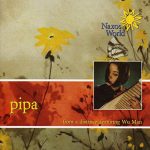
DC: Do you play the electric pipa in concert?
Wu Man: I have, yes.
DC: Do you perform with it often?
Wu Man: Not very often.
DC: Do you want to get people use to the traditional sound?
Wu Man: I think it depends, take the guitar. There are all kinds of guitars; people know there are all kinds of guitars: rock, classical, so it depends on what type of music you want to hear. It’s a good way to show how flexible it is. It’s an ancient instrument, we have this beautiful ancient elegant sound, but we can still be modern and electric.
DC: Where does the bowed pipa come in? Is that something you invented?
Wu Man: Well, that CD basically, when I recorded that CD, I wanted to see how the sound would be changed when I do different things. Before that I had opportunities to work with many different musicians; we did some experimental things. I wanted to see the changes in personality of this ancient instrument. I bowed the pipa because I saw some central Asian instruments where they were bowed and plucked and in Uzbekistan there is a bowed and plucked instrument, so I tried that on the pipa. Then for the electric Pipa, for recording I’d have a mic on the pipa and the first time I tried some distortion, I thought, “Hmm…. this is interesting let me try to write a piece.”
Plus, people always said I sound like Jimi Hendrix when I would play Ambush From All Sides. I did not know Jimi Hendrix when I came to this country. I would say, “Who is Jimi Hendrix?”
DC: People said that for Ambush? That’s not electric.
Wu Man: It’s not, (laughter) people said it sounds like Hendrix because of how wild Ambush sounds.
DC: Ambush From All Sides is one of the most amazing pieces in music for me. I thought it was contemporary, I was surprised when I learned it was written in the 1800’s.
Was the album from A distance a hard recording to make? I had that in my CD player for almost a year, before I changed it. I think it is one of my favorite CD’s.
Wu Man: Oh, thank you. It was not a hard album it was the most fun to record. It was a very different experience; all my recording were very classical and tradition this was a departure for me. Opposite and different direction.
DC: What was your parent’s reaction to Shanghai Blue’s and Bamboo Dreams?
Wu Man: Oh, they enjoyed it, my friends really liked Dancing.
DC: That is the second piece on the CD; I often keep that on replay.
Wu Man: The situation has changed since I left China. It is updated and modern. It’s not suppressed anymore. They see it as a way to preserving the tradition.
DC: On Vincent’s Tune you have your son singing a song that you wrote the piece around.
Wu Man: Yes, he was four at that time. Every day he sang that song. He always played this song on his toy piano. We don’t know where this song came from, it’s not Chinese, and it’s not American but he always sang it. I don’t think he got it from tv. One day when he was playing, I snuck in the room and taped him. He blushed the first time he heard it. He said mommy that’s my voice. I asked him, “Do you want to keep the CD?” He said he wants to keep it for when he’s older.
DC Does he call it “His” CD?
Wu Man: No, he says, “This is Mommies CD.”
Philadelphia, November 10, 2005 Part III
DC: You are having a question & answer after your show in Philadelphia. What are you asked most?
Wu Man: Am I? I didn’t know that. I know I will be doing a school program in the morning.
DC: Elementary school?
Wu Man: Yes
DC: What questions are you asked the most?
Wu Man: Depends, grown – ups are interested in my back ground, my education They want to know about the pipa history and my life in China. Kids ask how much I practice and how long does it take to get to the concert stage and how much money I have. It’s very cute.
DC: You are premiering two works in Philadelphia.
Wu Man: Yes, I am going to premiere a piece by Eric Moe. He did a pre-recording which will be totally differed instrument with percussion and vocals; kind of African style. The pipa voice will go in a different direction.
I will also premiere, and this is a world premiere: Pipa with Calligraphy and Video. It is the bigger piece with three movements. It is based on a poem from poet Li Bai. The video will be very dramatic, different character, different mood it will be the second half of the program. It was written by Composer Chen Yi and me. I am looking forward to it; I am very excited.
DC: It’s important to introduce new pieces.
Wu Man: I work with Chinese composers most of the time and premier their pieces. Why I’m doing it is like you said, to expand the instrument, not to just have twenty classical pieces. That’s why I want to create more literature for the instrument.
Since I am living in the States I have been working more with non-Chinese composers. They are enthusiastic and want to learn this instrument. You play the instrument you know the sound is so different, like different colors for a painter or a painter finding a new color. So, a lot of composers want to use this instrument, want to write something. I’m working with a lot of American composers, Terry Riley just premiered a quintet with Kronos. Philip Glass wrote a concerto where the pipa is the leading instrument. He also wrote for the Phillip Glass Orchestra, a theater piece where the pipa is the lead instrument.
I am curious to see non-Chinese composers, how they write for the Pipa. Most of their reality is very natural because they don’t know the background. They don’t have the heavy history of the instrument so they can write whatever they feel. So it’s very natural. It’s like a Chinese composer writing for the piano or ballet.
DC: I can’t wait until you concert; thank you for this interview.
Wu Man: Thank you.
Can I ask you, what piece are you working on?
DC: I am working on Dance of the Yi People.
Wu Man: That is my favorite piece. I will be playing that in Philadelphia; I will also play Ambush.
Home |